
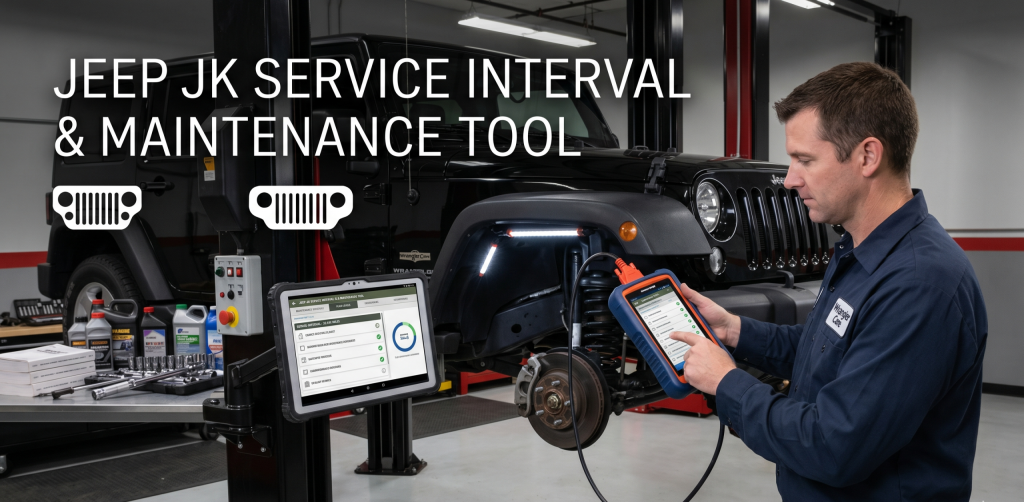
Maintenance / service intervals
Service the Jeep you own, not a generic checklist.
Make maintenance visible: start with the actual vehicle history, use the scheduler to organize priority, then verify the procedure-specific information before work begins.
- Historywhat is known and overdue
- Intervalwhat deserves attention now
- Referencewhat must be verified
Choose the next useful path
Every route links to a relevant working page.
Practical field notes
A maintenance interval is only useful when it matches the Jeep in front of you.
The scheduler organizes a starting point. A responsible service decision still combines the exact configuration, confirmed history, age, miles, leaks/noise/behavior and the procedure-specific factory reference.
- Have readyModel year, engine, transmission, axle and current mileage.
- Look forRecords, fluid condition, leaks, warning lights and unusual behavior.
- Use nextThe matching owner manual and vehicle-specific maintenance schedule.
Why is mileage alone not enough?
A low-mileage Jeep can still have time-dependent service needs, unknown history, fluid contamination, seal aging or wear created by use. Mileage helps sequence attention; it does not prove condition.
What should a useful maintenance record contain?
Record date, mileage, exact work completed, fluid or part used, observations and anything that remains uncertain. This creates a better handoff for the next owner, shop or diagnostic step.
When should self-service pause?
Pause when the procedure, torque/fastener condition, brake or steering safety, leak source, or vehicle behavior cannot be verified. A page can frame the decision; it cannot inspect the Jeep remotely.
Keep Your Jeep Wrangler JK Running Forever Proper maintenance is the key to preventing expensive repairs and keeping your 2007-2018 Jeep Wrangler JK reliable both on the road and on the trail. Whether you are running the early 3.8L V6 or the newer 3.6L Pentastar engine, strictly following the factory service intervals is critical.
Missing oil changes, differential fluid swaps, or vital suspension inspections can quickly lead to bigger problems like Death Wobble or engine failure. Use our interactive Jeep JK Maintenance Schedule Tool below to stay ahead. Simply select your current mileage or timeframe, and instantly get a comprehensive checklist of what needs to be inspected, replaced, or serviced right now.
Find the next technical path
Need a broader map before choosing a service task? The Jeep JK Technical Encyclopedia connects maintenance, diagnostics, steering, specifications, fitment, calculators and build planning in one starting path.
Start with your Jeep, not a parts list
Use this schedule as part of a complete ownership baseline. Start with JK Start Here, organize observations with the First 30 Days Checklist, and use the Modification Planning Checklist before turning maintenance questions into an upgrade purchase.
Technical scope and sources
This hub/tool is an educational navigation and planning resource for Jeep Wrangler JK owners. The linked guidance is conditional on model year, engine, axle, trim, modification history and vehicle condition; use the exact procedure and specifications for the vehicle in front of you. For baseline operating and maintenance information, consult 2018 Jeep Wrangler JK Owner’s Manual and Mopar’s JK maintenance schedule, then use matching factory service information for repair-specific work. Read the OffroadMe editorial standards for how we distinguish factory information, diagnostic context and modification considerations.
Jeep Wrangler JK Maintenance Schedule & Service Intervals
The definitive factory service manual (FSM) guide for maintaining your 2007-2018 Jeep Wrangler. Complete fluid capacities, torque specs, and interactive mileage-based scheduling.
JK Fluid Capacities & Specifications (3.8L vs 3.6L)
Using the correct fluid type and volume is critical. Below are the definitive factory specifications for both the early EGH 3.8L V6 and the newer Pentastar 3.6L engines.
| Component | 2007-2011 (3.8L V6) | 2012-2018 (3.6L V6) |
|---|---|---|
| Engine Oil | 6.0 Quarts (5W-20) | 6.0 Quarts (5W-20) *2013+ may use 5W-20 or 0W-20 |
| Engine Coolant | 13.4 Quarts (HOAT – Orange) | 10.5 Quarts (OAT – Purple/Pink) DO NOT MIX HOAT AND OAT! |
| Automatic Transmission | 42RLE (4-Spd): ATF+4 | W5A580 (5-Spd): ATF+4 |
| Manual Transmission (NSG370) | 1.59 Quarts (Mopar Manual Trans Fluid or Synchromesh) | |
| Transfer Case (NV241) | 2.0 Quarts / 4.2 Pints (ATF+4 Only) | |
| Front Axle (Dana 30/44) | 1.35 Quarts / 2.7 Pints (80W-90) | |
| Rear Axle (Dana 44) | 2.37 Quarts / 4.75 Pints (75W-140 for Towing/Severe) *Add Friction Modifier if equipped with Trac-Lok LSD |
|
Interactive Service Scheduler
Generate a custom factory-recommended maintenance list based on your specific JK setup.
Service Action Plan: Miles
The “Death Wobble” Prevention Protocol
Routine fluid changes are not enough for a solid front-axle vehicle like the JK. To prevent the infamous “Death Wobble”, every 10,000 miles you must inspect the following components for play or worn bushings:
- Front Track Bar: Check both the frame-side bracket bolt (125 ft-lbs) and the axle-side bolt (125 ft-lbs).
- Tie Rod Ends & Drag Link: Inspect grease boots for tearing and check for vertical/horizontal play.
- Ball Joints: Jack up the front axle and use a pry bar under the tire to check for vertical movement. Factory plastic-lined ball joints typically fail between 40k-60k miles.
Need exact torque specs for your suspension? Visit our Master JK Torque Specification Database.